Internet of Things Applications

Internet of Things Applications

  • Home
  • About us
  • Advertisement
  • Contact
UK-based "internet of things" startup EVRYTHNG, has raised a $24.8 million Series B round of funding that it hopes will help it give every physical product a digital identity.


EVRYTHNG works with clients such as Coca-Cola and packaging companies like Avery Dennison RBIS, Crown Holdings, and West Rock to connect consumer products to the web as soon as they are manufactured.

The company describes itself as a data management platform that allows businesses to have a more complete overview of their supply chain by assigning digital identities to products, allowing them to be tracked.

[...]

Niall Murphy, EVYRTHNG cofounder and CEO, told Business Insider: "We called the company 'EVRYTHNG' because we wanted to manage the digital identity of all the products in the world and that mission and vision is what we are after. To get there we have to build a relationship with product manufacturers and a tighter integration with the way products are built and sold so we can build at scale."

[...]


See more at: businessinsider.com
1
Share
Normally, silicon chip announcements don’t catch my eye. This is not to say that chips are unimportant; they are critical to achieving the goals for the IoT. Generally, however, I tend to take a higher level and more holistic approach to IoT subjects. That’s why, when 3 recent announcements caught my eye, I thought there might be more here than just “typical” chip announcements. These may be signals of some significant future direction for IoT communications.


The first announcement was ARM Holdings ’s acquisition of two companies providing NB-IoT technologies. NextG-Com offers a complete layer two and three software stack for NB-IoT, and Mistbase provides a complete NB-IoT physical layer implementation solution. As a reminder, ARM had already ventured into the wireless space, having acquired Wicentric for its Bluetooth stack, and Sunrise Micro Devices for its integrated Cordio Bluetooth 5 and 802.15.4 intellectual property (IP) short-range technologies.

Last week I provided my thoughts (Hype Vs. Reality: When Will Internet Of Things Networks Appear?) on the timing of NB-IoT (now called LTE-NB1). LTE-NB is going to be one of the most pervasive IoT connectivity technologies for at least the next 5 years—when it finally arrives. What is significant is that ARM, the leader in core technologies for IoT applications, has bet on LTE-NB for its long-range customers. To me, that speaks volumes as to the desire for system providers to use these three connectivity technologies for their IoT applications.

The second announcement was by Qualcomm QCOM +0.52%, who announced two chips: the QCA4020 and QCA4024. The SoC QCA4020 is a tri-mode device, integrating Dual-band Wi-Fi, Bluetooth Low Energy 5, and 802.15.4. As a reminder, 802.15.4 is the basis of both ZigBee and Thread. The QCA4024 is dual-mode, and integrates Bluetooth Low Energy 5 and 802.15.4.


See more at: forbes.com
1
Share
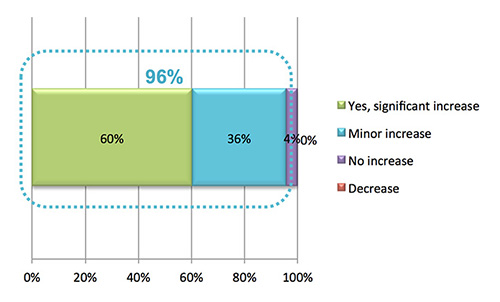
A new Dimensional Research survey looked at the rise of Industrial Internet of Things (IIoT) deployment in organizations, and to what extent it is expected to cause security problems in 2017.


IIoT are the connected devices in critical infrastructure segments such as energy, utilities, government, healthcare and finance. The study revealed that:
- Ninety-six percent of those surveyed expect to see an increase in security attacks on IIoT in 2017.
- Fifty-one percent said they do not feel prepared for security attacks that abuse, exploit or maliciously leverage insecure IIoT devices.
- Sixty-four percent said they already recognize the need to protect against IIoT attacks, as they continue to gain popularity among hackers.


“Industry professionals know that the Industrial Internet of Things security is a problem today. More than half of the respondents said they don’t feel prepared to detect and stop cyber attacks against IIoT,” said David Meltzer, chief technology officer at Tripwire. “There are only two ways this scenario plays out: Either we change our level of preparation or we experience the realization of these risks. The reality is that cyber attacks in the industrial space can have significant consequences in terms of safety and the availability of critical operations.”


See more at: helpnetsecurity.com
0
Share
Most consumers don’t know what “the Internet of Things” means, and People Power’s David Moss thinks he knows why.

“Before you can experience what an Internet of Things is, you actually first have to go out and buy an internet-connected thing,” he said Wednesday night at Town Hall Seattle, during an MIT Enterprise Forum presentation about intelligent homes. “And why would you go buy an internet-connecting thing if you don’t know what value it can add to your life?”

To capitalize on the Internet of Things, or IoT, People Power came up with a free app called Presence, which turns a spare smartphone or tablet into a Wi-Fi home security camera.

Moss said he was amazed to discover that the app was being used for much more than home security.


“We had created a new thing, but I soon found out that the Internet of Things is actually not just about things,” Moss said. “While I was enamored with how cool it was to check in on my house from anywhere in the world, the stories that we were getting from our users were really about how they were connecting with other people, and their pets. The thing they had, this app, was just a way to connect with what mattered most to them.”

The way Moss sees it, calling the technology the “Internet of Things” doesn’t describe its true power. “I personally prefer the term ‘ambient computing,'” he said.

And however you call it, the technology is on track to become much more powerful, thanks to cloud computing – which provides the “brains” for the Internet of Things – as well as the social dimension.

See more: geekwire.com
1
Share
The pitches have already started: Various vendors promise to help you manage the tsunami of internet of things (IoT) devices coming. But beware: IoT management will be very difficult for a long time, and it may never reach the steady state of mobile management.


Potential good news: You likely won't have a flood of IoT devices coming from all quarters as we saw in the early days of mobile BYOD. But what IoT devices you have will be very hard to manage.

Remember when there were iPhones, Android smartphones, BlackBerrys, WebOS phones, Windows Phones, and legacy Windows Mobile devices? IT shops freaked out at all the variations they'd have to support.

Imagine an IoT world where thermostats, door locks, light switches, elevator stop regulators, smart glasses, Bluetooth internal-location sensors, comm badges, security cameras, heat sensors, conference gear, alarms, and the gazillion other devices and sensors that might exist in the products you use and environments you manage -- as well as the possible IoT devices and sensors in health care, transportation, oil exploration, logistics, retail, and public safety. In comparison, the half-dozen mobile devices that so freaked out IT look as frightening as a sleeping cat.

[...]

The best example here is Wi-Fi. Until the Wi-Fi Alliance, a vendor group, came up with the Wi-Fi wireless compatibility standard, businesses refused to adopt wireless LANs in any volume because pre-Wi-Fi devices could only talk to other devices from the same company, though they all used the same 802.11 transport protocol.

One example in IoT is the Data Distribution Service, a set of APIs and data transfer protocol from the Object Management Group. This lets various manufacturers' devices talk to various manufacturers' analytics back ends.


We'll see both patterns occur in IoT. But it will take years for the shift to either approach in each domain. In the meantime IT will be faced with a grim reality: Most IoT products will have their own security models and management tools, creating an unwieldy mess for IT. That'll slow IoT adoption out of necessity.

In the industry standardization game, someone has to blink first, but the stare-down will go on for years until someone finally has to back off. In the meantime, pick and choose your IoT initiatives carefully -- you'll be able to handle only so many of them.

See more at infoworld.com
2
Share
The EU has floated a new idea to boost the security of Internet of Things (IoT) products – get manufacturers to stick labels on them telling buyers how secure they are.


It sounds simple enough. Products such as fridges, washing machines and ovens are already sold in the EU with mandatory energy efficiency ratings, so why not something similar for security?

In comments made at a weekend press conference, EU deputy commissioner for digital economy and society, Thibault Kleiner, spelled out some of the organization’s worries about the state of IoT.

Ever greater numbers of products were being sold with an IoT connectivity as a standard feature, he said.

[...]

Despite there being at least five billion devices in service with IoT capability – Gartner reckons that this is expanding by 5.5 million new devices every day – security standards are only just emerging. Meanwhile, default security is often weak.

A warning of the potential for trouble came with the recent record-breaking DDoS attack on cybersecurity blogger Brian Krebs. The ‘Mirai’ botnet that generated this huge wave of traffic came from an army of poorly-secured network cameras, digital video recorders (DVRs), routers and printers.

The Commission believes that labels guaranteeing adherence to basic security standards would encourage manufacturers to work together more closely in the spirit of common interest.

[...]

The EU is doing its best to speed up development, investing €192 million in IoT research as part of its Horizon 2020 programme.


Unfortunately, IoT devices need better security now, not years from now when the EU has agreed what the labels should look like – and mean.

What consumers and businesses will think about having another label to peel off shiny new IoT products when pulling them out of the box remains an unknown.

Will they have faith in them? Or will they end up feeling disappointed should securing IoT devices from real-world threats turn out to be more complex than the label suggests?

See more at sophos.com
0
Share
The AllSeen Alliance, a pioneer in the so-called Internet of things, and Open Connectivity Foundation, a rival group, said on Monday that they will combine their efforts to speed up the adoption of connected devices.


In theory, this means that appliances or other gadgets using either the AllSeen-backed AllJoyn technology to connect online or OCF’s IoTivity technology will work together and that the combined alliance will sponsor both AllJoin and IoTivity as open-source projects, meaning that the related software will be freely available.

That newly expanded group, which will go by the OCF name, brings together a host of tech companies including Microsoft MSFT -1.31% , Intel INTC -1.84% , LG Electronics, Qualcomm QCOM -1.62% , and Samsung. They all have a vested interest in selling either the devices themselves, the connective tissue that ensures the devices can communicate, or associated services delivered by the connected system.


Executives from various member companies including AB Electrolux, Canon, Cisco Systems CSCO -0.99% , GE GE 0.42% Digital, Haier, Intel, LG Electronics, Microsoft, Qualcomm, Samsung Electronics will sit on an expanded OCF board of directors.

See more at: fortune.com
0
Share
It is pretty much a given that social, economic, and political forces shape the demand for new technologies. Demography is “destiny” in the sense that the demand for new products and services depends on the number of people and on their ages, genders, locations, and cultural heritages. Economics also matter because the arrangement of economic activities and the amount and distribution of wealth affords some people the opportunity to purchase new goods and services while constraining the ability of others. Politics plays a messier role by providing ways for incumbents to hinder the entry of competitive new technologies and at the same time allowing enthusiasts opportunities to direct subsidies to favored options.


Many frustrated technologists with Libertarian sympathies agree with Sir Ernest Benn (in a quote that is widely misattributed to Groucho Marx) who said that “politics is the art of looking for trouble, finding it everywhere, diagnosing it incorrectly, and applying the wrong remedies.” Others look skeptically at the evolving direction of technology and desire political interventions to protect security, safety, health, and human dignity.

[...]

This brings the story back to politics. When technological innovations begin to diminish our lives, people react. They demand protections, regulations, and public oversight. Savvy technologists anticipate this dynamic and work hard to design the undesirable features out of the system, impose codes of conduct to discourage malfeasance, and avoid unsavory business models. Yet self-regulation has limits, especially in a global context lacking universal norms. Governments need to backstop self-regulation with strong legal liability laws and clear regulations that prohibit bad behavior. When governments themselves are the problem, their citizens need to step into the voting booth or onto the street to redirect society’s institutions.


Calls for governmental intervention and political action are rarely welcomed in tech circles, where more Libertarian views often prevail. However, politics is clearly part of the toolkit for ensuring that the IoT and other innovations improve the human condition. Good design, strict professional norms, and honorable business practices play key roles, but so do tort liability and governmental regulation, as well as social protests and political action. Creative leaders as diverse as architect Frank Gehry and writer Ernest Hemingway (who never had quotes misattributed to Groucho Marx) uniformly agree that constraints drive genius. This outcome has also been confirmed in technology development, so those creating the IoT should embrace its emerging political constraints.

See more at: iotevolutionworld.com
0
Share
Finding a way to adequately serve firms in the internet of things (IoT) space is the next area customer relationship management (CRM) providers need to target, according to electronics giant Schneider Electric.


“We want to make the IT and IoT world converge with a lot of customer context. If you have a lot of data generated without context, you cannot sell to a customer in a great way. It’s about connecting the dots so you better know the usage of buildings and devices,” Christophe Blassiau, senior vice president for customer experience and CRM at Schneider told the Sunday Business Post.

Blassiau made the comments at Dreamforce, Salesforce’s annual gathering in San Francisco which is attended by 170,000 people.

Tony Wells, senior vice president for marketing in North America with Schneider, said he expected artificial intelligence (AI) to play a pivotal part in bridging the gap.

“Being able to take the velocity, variety, and volume of this data being generated and being able to make sense of it is crucial. AI is going to play a role to work out what data really matters. There’s a huge amount of value that can be extracted from data but it has to provide benefits to customers and to us as a brand,” said Wells.

[...]

Wells said this increase in customer demand had also presented challenges and opportunities from a marketing perspective.

“Customers aren’t coming to the company they buy from first when they are making a purchasing decision, they are usually 70 per cent of the way down. For us it’s about finding the right salesperson who can call on that salesperson and respond to their inquiries as quickly as possible,” said Wells.

See more at: businesspost.ie

0
Share
The term Internet of Things (IoT) brings to mind the stereotypical image of a working woman who triggers the cooker at home as she leaves office to drive back home or a refrigerator which sends a replenishment note to a grocer as soon as it senses some of the frequently required items such as milk or butter are exhausted. Given the numerous possibilities which IoT can inspire, many large product companies have already embarked on programs to build IoT compatibility into their existing or new products.


What is IoT?
The Smartphone as a device of communication is an IoT device and knowingly or unknowingly we have already been using it. IoT enables each device or thing to communicate with other devices or things and perhaps be directed or direct the actions of other such devices.

An IoT enabled device must have a built in microcomputer and suitable sensor devices which will sense /capture important parameters in real life. In addition, it must have access to and be identifiable with a unique IP address. Increasingly, there are standard electronic communications modules available which could be connected to any device which you wish to enable them for IoT. The costs of such modules and standardized interfaces may seem a bit high as of now but this situation will certainly improve with increased demand and availability.

[...]

IoT makes the owner omnipresent
in most food cooking and retail businesses such as a cookie/bakery stores, the owner is required to formulate an hourly forecast and plan the production accordingly .This plan has to be adjusted based on the day of the week, time of the day , cultural and religious sensitivities , seasonal variations as well as actual walk-ins into the shop. When the owner is away, the ability of the team to replicate such expertise becomes a challenge. IoT can help the owner to encapsulate his expertise in the form of business rules into the bakery systems which allows his team to exercise their judgment but within bounds and send alerts to the owner in cases of deviations and exceptional situations. The owner’s expertise is thus at hand at all times irrespective of his location. MSME with multi-locational operations can thus benefit immensely from the owner’s expertise.

IoT and autonomous systems
The machines learn with every transaction, production or service experience. This means that the encapsulated business rules in the controller attached to the machine can be changed based on new experiences. The communication between the machine, sensors, business rules engines and the machine learning algorithms on a central server all interact thanks to IoT. Add to this the ability of the machine to initiate actions on its own and we have ‘autonomous machines’ and in a larger sense processes and systems which can run on their own like the autopilot of an aircraft.

[...]

In Conclusion
MSMEs can now manage their resources efficiently and effectively, create smarter products and build smarter services using the power of the IoT and associated technologies. The challenge of scalability and replicability of the owner’s experience and personal skills which are perhaps the biggest concerns among MSMEs can be dealt with quite effectively by IoT. Finally, IoT itself is a great opportunity for innovation and new product/service/business models. A proactive move in this direction would ensure that MSMEs find the path to growing into a dominant component of the emerging ‘Smart’ economy.

See more at: forbesindia.com

0
Share
This week, the Raspberry Pi Foundation announced it has sold more than 10 million Raspberry Pi boards and celebrated the milestone by releasing a new Raspberry Pi Starter Kit. While many of these Linux-driven hacker boards were used for the foundation’s original purpose -- creating a low-cost computer for computer education -- a large percentage have been sold to hobbyists and commercial developers working on Internet of Things (IoT) projects ranging from home automation to industrial sensor networks.


Linux-driven open source and commercial single board computers and modules sit at the heart of the IoT phenomenon. They are usually found in the form of gateways or hubs that aggregate sensor data from typically wirelessly enabled, sensor-equipped endpoints. Sometimes these endpoints run Linux as well, but these are more often simpler, lower-power MCU-driven devices such as Arduino-based devices. Linux and Windows run the show in the newly IoT-savvy cloud platforms that are emerging to monitor systems and analyze data fed from the gateways in so-called fog ecosystems.

Over the next few weeks, I’ll be analyzing the IoT universe, with a special focus on Linux and other open source technologies used in home and industrial automation. I’ll look at major open source products and projects, IoT-oriented hacker boards, security and privacy issues, and future trends.

[...]

See more at: linux.com

0
Share
Builders of the Internet of Things (IoT) have long promised consumers a more convenient future: We will all live in “smart homes” where surveillance cameras, thermostats and garage door openers will turn on and off automatically, our groceries will order and deliver themselves into our refrigerators, and our speakers will know our taste in music. In our “smart cities,” always-on surveillance systems will crack down on crime and sensor-driven roadways will put an end to traffic.


Yet this hyper-efficient, IoT-fueled future is years away and plenty of pundits and investors are talking about consumer IoT as a too-hyped trend that’s failing to take off. According to a 2016 Accenture survey, consumer demand for smartphones and IoT devices is stalling. So why aren’t consumers snapping up the new technology?

Industry insiders say the barrier is a lack of standards: connected devices can’t talk to each other, and each device comes with its own app, rather than being managed from a single point of control. Others think jargon-y marketing is to blame: Consumers still scratch their heads when they hear “Internet of Things.”

[...]

The potential power of IoT is truly awe-inspiring, but in order to boost sales and drive demand beyond the early adopter set, we need to stop making toys no one cares about and instead work on building simple solutions to real, everyday problems for real people.

See more at: forbes.com

0
Share
There is no hotter tech sector right now than the Internet of Things (IoT). Everybody and anybody who is offering an internet connected device has an IoT story. As with many hot technology markets, there comes a lot of noise and confusion. Just in the consumer IoT market alone, there are multiple competing platforms and not all of them enable devices to interconnect with each other. In the industrial IoT (IIoT) market, not only are there competing platform vendors, but there are many industry organizations trying to define IIoT interoperability. Confused yet? Just wait…

Now, when we start to talk about security, there is even more confusion on where to get started and how to implement a security strategy. There are no fully defined or adopted standards, or security architectures for either consumer IoT or IIoT today. Many consumer IoT device manufacturers are sacrificing strong security measures to get devices to market. This could create serious issues down the road if vulnerabilities are exploited and devices cannot be secured. In the IIoT market, industry groups such as the Industrial Internet Consortium (IIC) and Trusted Computing Group (TCG) are actively working with security vendors on frameworks for IIoT security. But, these frameworks are still in the early stages and interoperability will need to be tested and addressed before they can be fully rolled out and implemented.

Before I discuss how you can get started with an IoT security strategy today, I just want to reiterate why we want to connect things. The benefits are simple – greater access, control, efficiency and optimization. When everything is connected and communicating, things work together, we can access these things from everywhere and anywhere and collect, share and analyze data to better manage our homes, our health, our cars, the environments where we work and operations of industry. All of this connectivity leads to higher performing systems, cost savings and new revenue streams.

[...]

In order to go to market today, IoT device manufacturers need to begin implementing security in the early design phases of their products. Security can no longer be an afterthought as it has in the past with so many legacy connected device and products. Trying to retrofit security into devices already in use can be difficult, costly and a burden on the users.

Key benefits of building identity in from the start:
- Gain a Competitive Advantage – Build identity into your IoT devices and services to leverage secure functionality as a competitive advantage.
- Offer a Superior User Experience – Make security and identity easy to offer your customers provides a positive user experience.
- Brand Reputation and Integrity – Assure products and software code are legitimate. Don’t let counterfeit products and malware impact your brand.
- Privacy and Safety Ensured – Ensure sensitive data remains private and the safety of your customers and users is not jeopardized by a malicious attack.

See more at: globalsign.com

0
Share
You hear a lot of people talking about how great life will be when cars drive themselves and the Internet of Things is fully deployed. But while many of us dismiss this chatter as background noise, one industry is paying close attention and champing at the bit to get started.

Yes, of course, it's the advertising industry. After all, when cars drive themselves, you'll have more time to look at the ads that will be popping up on strategically located screens. Your refrigerator will automatically order almond milk, egg whites, and fat-free butter while it tries to get you to try a new kind of genetically engineered hot dog.

Right at the moment, the advertising trades are obsessing over self-driving taxis and dreaming of the contextual ad possibilities they present.

[...]

Or as Hewitt put it in his interview with the Daily:

“Not too far into the future the ads will be contextually presented and may also be served up as bite-sized services instead of just targeted display advertising.”

If everything works out as planned, it will be just like having a little person on your shoulder, constantly nagging you to do all the things your favorite brands want you to do.

See more at: consumeraffairs.com

0
Share
For those of us Boomers who have witnessed first hand the invention, application, proliferation and ultimately the world domination of the Internet, it might all seem like sort of a blur.


Doesn’t it feel like just yesterday that the nerdy guy in your office barged into your cubicle, took control of your IBM PC or Compaq or maybe even your Mac SE, and logged onto NetScape?

“This is the future of computing,” he might have said as you studied the awkwardly formatted text slowly rendering across your screen. I remember my reaction:

“Bull pucky! Where’s the sound, the music, the voice-over, the animated graphics, the color photos, the video windows?”

It must have been around 1994, and multimedia on CD-ROM, created in a popular authoring tool called MacroMind Director, was all the rage. How could the snail-paced, text-based content delivered on the NetScape browser over the World Wide Web possibly supplant the showbiz content we could deliver on CD-ROM?

[...]

Some of us, regardless of the breadth or our attack surface and whether or not we like adjusting the temperature of our refrigerator from the golf course, are donning an extra layer of protection in the form of a Virtual Private Network (VPN). This service allows us to encrypt the data that travels from our devices to our Internet service provider. Corporations have employed them for years, which is what our corporate friends are talking about when they refer to information “behind the firewall.” VPNs aren’t a guarantee of complete safety, but they make our data more difficult to hack.

The net-net of it all: if we want to keep something private we’d better keep it offline, to the extent that we can. It may be a little more difficult to teach our kids, and especially our grandkids, about things like 35mm film, padlocks with real keys, checkbooks and other rapidly disappearing devices of the analog age.

Who ever would have thought that so much havoc could be wreaked with a bunch of zeros and ones?

See more at: huffingtonpost.com

0
Share
As is the case with several other popular tech buzzphrases -- "big data," "cloud computing" and "cybersecurity" come to mind -- dozens of companies have talked up their investments in what they deem to be the "Internet of Things," or IoT. Big-name chipmakers, telecom service providers and cloud service providers all fit the bill here. But a look at just how much IoT exposure these companies have often shows that hype far exceeds reality.


[...]

Second, Gartner expects about two-thirds of the connected things that will be in existence in 2020 -- 13.5 billion -- to be consumer devices. This appears to include smartphones and tablets, and broadly contains a number of products that aren't likely to fuel major growth for telecom or cloud service providers angling to profit from a surge in the number of connected devices.

0
Share
Talk to Josh Corman long enough and the beeps and blinks of the Internet of Things (IoT) devices that increasingly dot our world take on a terrifying shape.


"There are more devices and more types of devices, so this just gives you more ways for people to track you or hurt you," Corman, a long-time security expert and cofounder of I Am The Cavalry, says. "What we've done is blindly assume that [adding software and connectivity] is always good. And we're making really horrible, horrible choices."

Corman founded IATC—a cybersecurity research non-profit focused on reducing IoT-related public safety risks—with security researcher Nick Percoco at a 2013 hacker conference. Medical devices are a big area of concern for Corman and his group. Besides vulnerable insulin pumps and pacemakers, hacker-researchers have shown high-tech hospital equipment—from Bluetooth-enabled defibrillators to remotely controlled drug infusion drips—could be manipulated toward grievous, even deadly, ends. IATC is also keeping an eye on connected cars, home security and automation systems and "smart" public infrastructure, like utility grids and traffic control.

[...]

"The majority of the security industry has been focused on private sector, protecting a bank or credit cards," points out Corman. As software started springing up in insulin pumps and cars, he became more concerned. "I’m thinking, 'Guys, we can’t even secure credit cards with $80 billion of our best and brightest—why are we putting dependencies in areas that can kill people?'"

Through IATC, Corman and a network of volunteer cybersecurity experts and whitehat hackers have developed a five-point list of standards for connected cars and have started collaborating with the Society of Automotive Engineers. He plans to release similar guidelines for other "life and limb" applications of the technology, including medical devices and public infrastructure.

But security remains an optional pursuit for manufacturers. "IoT technologies in general don’t have good security," says Susan Landau, faculty member at Worcester Polytechnic Institute and a distinguished scholar on cybersecurity and privacy issues. "There are no legal frameworks that demand good security. We’re racing ahead yet again without putting the security and privacy in."

[...]

Tien suggests that the fact that the well-meaning motivation that powers data collection in public places—for "smart city" initiatives, for example—helps normalize the Big Brother-esque creepiness of Big Data.

"There is a real attraction to what I would call dangerous surveillance practices when those practices are aimed at people and their everyday lives and trying to solve urban problems," he says. "If you associate the surveillance with Dick Cheney it’s bad; if you associate the surveillance with Bill de Blasio that is another thing."

[...]

President Obama’s administration has taken up cybersecurity as a national safety and security issue with a recent push to enlist the help of private industry. In January, Obama proposed legislation that would help shield companies that share online-threat data with the government from lawsuits, and last month he signed an executive order that urges (but does not require) companies to share information on cybersecurity threats more broadly, in the interest of improving threat protection systems.

[...]

Corman and other experts agree that the FTC’s broad recommendations for IoT manufacturers—build security in at the outset, implement lifecycle monitoring, train employees in security—are on the right track. But with the industry consigned to self-regulation for now, the current growing pains of data, security, and privacy within the IoT are likely to persist.

"We’ve moved into a completely new world," says Landau. "We are facing massive losses of privacy and, until we learn how to operate in it—we, the public, and we, the government—getting protection for it is going to be awkward. Or more than awkward."

See more at: fastcompany.com

0
Share
The healthcare industry is plagued with data breaches and other cybersecurity nightmares. At the same time, connected medical devices – components of the so-called Internet of Things – are multiplying, opening more holes in security and creating terrible potential for patient casualties.


Without doubt, unsecured medical devices currently are putting hospitals and patients at risk, according to “Healthcare’s IoT Dilemma: Connected Medical Devices,” a new report from Forrester Research analyst Chris Sherman.

“You have less control over connected medical devices than any other aspect of your technology environment,” the report said. “Many times, vendors control patch and update cycles, and vulnerabilities persist that require segmentation from your network. Considering that many of these devices are in direct contact with patients, this is a major cause for concern.”

Additionally, medical devices are vulnerable to four attack scenarios, the report said. “Threats against medical devices include denial-of-service (DoS), patient data theft, therapy manipulation and asset destruction,” the report said. “Each represents risk to your organization, with DoS currently being the most severe.”

[...]

1. Categorize existing devices based on risk.

Once an organization places a device on a network, it becomes part of a connected system. Websites like Shodan (“The search engine for the Internet of Things”) expose thousands of searchable end-points around the world that lack security and/or use default passwords.

“There are five key factors that contribute to the risk rating of any medical device: Potential impact to patient safety; Network connectivity; Data sensitivity; Likelihood of attack; and Vendor security SLA,” the report said. “For starters, use industry risk assessment guidelines, standards and expertise. The Medical Device Innovation, Safety and Security Consortium (MDISS) provides a space for industry leaders to collaborate and exchange ideas; the National Cybersecurity Center of Excellence (NCCoE), established by the National Institute for Standards and Technology (NIST), released its first cybersecurity practice guide last year called ‘Securing Electronic Health Records on Mobile Devices’; and Forrester Research’s Medical Device-Risk Heat Map can help categorize devices based on risk.”

2. Implement a clinical risk management framework.

The International Electrotechnical Commission (IEC), for example, publishes voluntary standards across various technology industries.

[...]

3. Ensure that your organization follows basic security hygiene.

Forrester Research reported that the vast majority of healthcare breaches in the past few years were due to social engineering and spear-phishing attacks. These problems have known solutions, but these solutions often demand a major cultural change by an organization.

[...]

4. Include security requirements in new device requests for proposals and contract language.

Medical device manufacturers generally are not required to include security controls on their devices nor provide guidance to their customers on how to protect devices. But healthcare organizations, as potential customers, have the power to get manufacturers to do so.

[...]

5. Apply a zero trust networking architecture.

[...]

See more at: healthcareitnews.com

1
Share
The world’s best athletes are currently on display at the 2016 Summer Olympics in Brazil, and some are using wearable technology powered by the Internet of Things to help them go for the gold.


United States sprinter Allyson Felix has reached Olympic glory already, taking home gold medals in the 2008 Olympics in Beijing and the 2012 Olympics in London, but she is still looking for a leg-up on her competition. According to a report from The Huffington Post, she is just one of several athletes embracing wearable IoT technology as they look to improve their training and boost their performance in the games.

Felix trained for her upcoming track-and-field events with a pair of 3D-printed shoes designed specifically for her feet. The sneakers not only conform perfectly to her foot but provide Felix with feedback on her performance.

[...]

It’s not just American athletes, as South African track-and-field star Willem Coertzen trained for Rio using a Hexoskin smart shirt. The shirt, like the Solos eyewear, can measure information like heart rate, speed, breathing patterns and other biometric indicators.

Wearable technology is having a significant impact on the space, as can be seen in the PYMNTS.com Internet of Things Tracker. The latest tracker features several news stories about companies investing in wearable technology in products ranging from speakers to athletic gear.

See more at: pymnts.com

0
Share
The Internet of Things may just hold the key to the future of banking, says Jacqueline Guichelaar, head of infrastructure and service delivery for Lloyds Banking Group. With the topic of transformation dominating banking industry conversations amid the race towards a digital future, it’s clear that the Internet of Things is driving that change.


The status quo simply cannot continue and the major new force that is IoT is serving to transform the industry from the inside out, pushed by the twin drivers of heightened customer and regulatory demand.

[...]

The Internet of Things enables a whole new level of personalised banking - indeed, the possibility of branches becoming equipped with sensing technology that can recognise customers as they walk in and respond to their own particular needs suddenly becomes a tantalising reality.

[...]

Hand-in-hand with the likes of the cloud and big data, IoT is set to be implemented on a massive scale, creating major new business opportunities as we continue to embrace a world that’s connected like never before. It could even serve to be the differentiator that separates the winners from the losers in the race for true banking innovation.

Change is now a must - and IoT is set to be the key competitive advantage that helps tomorrow’s market leaders set the pace.

See more at: finextra.com

0
Share
Newer Posts Older Posts Home

Blog Archive

  • ▼  2017 (3)
    • ▼  March (3)
      • UK 'internet of things' startup EVRYTHNG raises $2...
      • Internet Of Things Connectivity Options Come Into ...
      • Most security pros expect increasing attacks on In...
  • ►  2016 (124)
    • ►  November (1)
    • ►  October (6)
    • ►  September (3)
    • ►  August (10)
    • ►  July (2)
    • ►  June (64)
    • ►  May (27)
    • ►  April (11)
  • ►  2015 (42)
    • ►  August (2)
    • ►  July (9)
    • ►  April (4)
    • ►  March (6)
    • ►  February (12)
    • ►  January (9)

Ana Creative Play

Xiaomi Coupon Code

Advertisement

Powered by Blogger.

Gadget Time

Loading...

Xiaomi News

Loading...

Parenting in the Digital Age

Loading...
Copyright © Internet of Things Applications

Created By ThemeXpose